Welcoming the Class of 2026: English Literature Study Program FBS UNESA Unveils Academic Roadmap
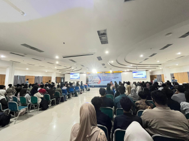
The English
Literature Study Program, Faculty of Languages and Arts (FBS), Universitas
Negeri Surabaya (UNESA), held an academic orientation and welcoming session for
the new batch of S1 English Literature students, Class of 2026. Organised with
the support of the English Literature Student Association (HMP AELS), the event
took place in the Auditorium on the 4th floor of Building T14, FBS UNESA.
The session
opened with an official address by the Head of the S1 English Literature Study
Program, Dr. Ali Mustofa, S.S., M.Pd. Following the presentation of a newly
designed bumper video showcasing the teaching staff and their areas of academic
expertise, Dr. Ali invited the lecturers seated in the front row to introduce
themselves individually. The lecturers shared practical tips, academic advice,
course outlines, and motivational insights to help incoming students navigate
their upcoming university journey.
During the keynote presentation, Dr.
Ali introduced the academic trajectory using the official Academic Book of the
English Literature Study Program, projecting its contents to guide students
step-by-step through their four-year curriculum:
●
Foundation Phase (Semesters 1 &
2): Semester 1 focuses on core skills and fundamental courses worth 19 credits,
including Essential Communication Skills, Intensive Reading and Writing Skills,
Extensive Reading and Listening, and Basic Phonetics, alongside general
university subjects. Semester 2 expands into 20 credits, introducing Critical
Oracy, Critical Literacy, Introduction to Literature, and Introduction to
Linguistics.
●
Core Competencies (Semester 3):
Students complete 24 credits covering key subject areas such as Prose
Appreciation, Poetry Appreciation, English Phonology, English Morphology and
Syntax, Argumentative Writing, and Global and Intercultural Communication.
●
Specialisation & Electives
(Semester 4): Students select their specialized track, either Linguistics
(covering Academic Writing, Research Methodology, Language in Society,
Semantics & Pragmatics, and Statistics) or Literature (covering Academic Writing,
Research Methodology, Drama and Performance, Critical Approaches, and Digital
Humanities), alongside mandatory subjects like English for Media Communication,
Translation, and English for Tourism.
●
Student Mobility & Experiential
Learning (Semester 5): The program offers a 20-credit conversion scheme through
Student Mobility (BKP) programs, enabling students to participate in industry
internships, research projects, community service, entrepreneurial initiatives,
or International Student Mobility.
●
Advanced Research & Fieldwork
(Semesters 6 & 7): Semester 6 builds specific research competencies for
thesis preparation across both tracks (24 credits total). Semester 7 mandates
the Proposal Seminar (2 credits) and offers specialized electives such as
Subtitling, Interpreting Practice, Creative Writing, Digital Storytelling, and
Audio Visual Translation.
●
Graduation Schemes (Semester 8): To
complete their degree (requiring a minimum of 144 credits), students can choose
between two final project pathways: authoring a traditional undergraduate
thesis (skripsi) or publishing an academic article in a journal indexed at
minimum in SINTA 4. Both options require a final Thesis Defense.
The
orientation session also highlighted international academic pathways, including
the International Credit Transfer Program, which allows students to take
specialized courses, such as Popular Culture Studies, World Literature, and
World Englishes, with global partner institutions.
The event concluded with an
interactive Q&A session, providing the incoming class with clear guidance
on their academic journey ahead.
Written by:
Nayla Atha Aqilia